A Little Life by Yanagihara
I’ve been putting off writing this review for a while because this book was easy to read but hard to buy and harder to review.
As shallow as it may seem, I avoided this book as long as I could because of the cover design. It looks like a movie (it isn’t) and the man on the cover looks like a crying Jim Carrey. Also the online mass content around this book didn’t help. You see lots of people crying and reading this book, they call it misery porn, they call it terrible and at the same time everything they say about the plot is underwhelming and vague.
Synopsis
By degrees, an enigmatic, brilliant and terrifyingly talented litigator becomes an increasingly broken man. Despite his successful career, his mind and body remain deeply scarred by an unspeakable childhood. He becomes progressively more haunted by what he suspects is a history of trauma he cannot overcome, and that he fears will define his life forever.
the book was shortlisted in 2015 for booker prize and I attached the synopsis from their website.
You also see that it’s being advertised as a queer book! This. Is. No. Queer. Book. Don’t believe otherwise… this is not the issue being discussed here.
Here’s also a quote from the author:
Yanagihara stated in a recent interview with The Standard that writing a gay novel was ‘never a sort of intention,’ and that ‘it was just who the characters happened to be.’ Is it fair to term A Little Life a ‘gay novel’? How central to the novel is the characs’ sexuality, and what relevance does it bear?
Now that we got all these out of the way, let me warn you the rest of this review is going to have spoilers all over because I essentially don’t believe spoilers are applicable to these kind of books.
The reason behind the title of the book is once mentioned somewhere in the book, but mostly I believe is about the book itself. It’s literally a little life. The author shares a little of the life of Jude, our MC. The book starts when Jude and his college friends move into a stage of adulthood where people stay in your life not because they have to, but because they want to. Friendships as chosen relationships, not because of college, orphanage, or sex. Actual companionship, which I think is, in a way, the true beginning of his life and the book ends when he dies.
Yes, told you, spoilers!
More about spoilers, the major events that happen in this book aren’t actually the important parts. What makes this book as acclaimed as it is are the descriptions of the echoes of those events. Like, you can’t spoil someone’s life story by saying: there was a man, he went to med school, got married, had two children, got cancer, and died. Sure, that is his life in summary, but it’s not him. It doesn’t capture his essence, his life. Same with this book, and ideally, with any book. You need to actually read it to understand Jude St. Francis’s life.
He experiences nearly every form of suffering a person can go through, and the author does not shy away from details. Across ~720 pages, we witness his trauma, his coping mechanisms, his relationships, his achievements, and his attempts to exist in a world that has never been kind to him.
The story is narrated by Jude, Harold (his adopted father) and his friends: Willem, JB, and Malcolm. these shifts feel like mercy. Staying only in Jude’s perspective would be almost unbearable.
And yes, so much of the book is basically a fairytale. Jude becomes a successful lawyer, is adopted at 30, and has friendships with men who are almost unrealistically emotionally intelligent and supportive. But the book is not trying to be realistic, it’s conducting an experiment in relationships and love.
It asks: What happens when someone who has only known cruelty is finally surrounded by unconditional support? What if everything tries to correct itself after it went terribly wrong?
This book is not inspirational. It is about hope as it feels, not as it is usually portrayed. It shows how a person pushes through trauma, lives with a damaged self-image, and tries not to be defined by suffering.
You can never fully heal, but you can endure life. That’s what the book says.
Yanagihara said that she wanted to ‘create a character who never gets better’ while exploring ‘the idea that there is a level of trauma from which a person simply can’t recover. I do believe that really, we can sustain only a finite amount of suffering.’ To what extent does this feel realistic? Does Yanagihara’s depiction of a person struggling with the legacy of childhood trauma feel true to life? >
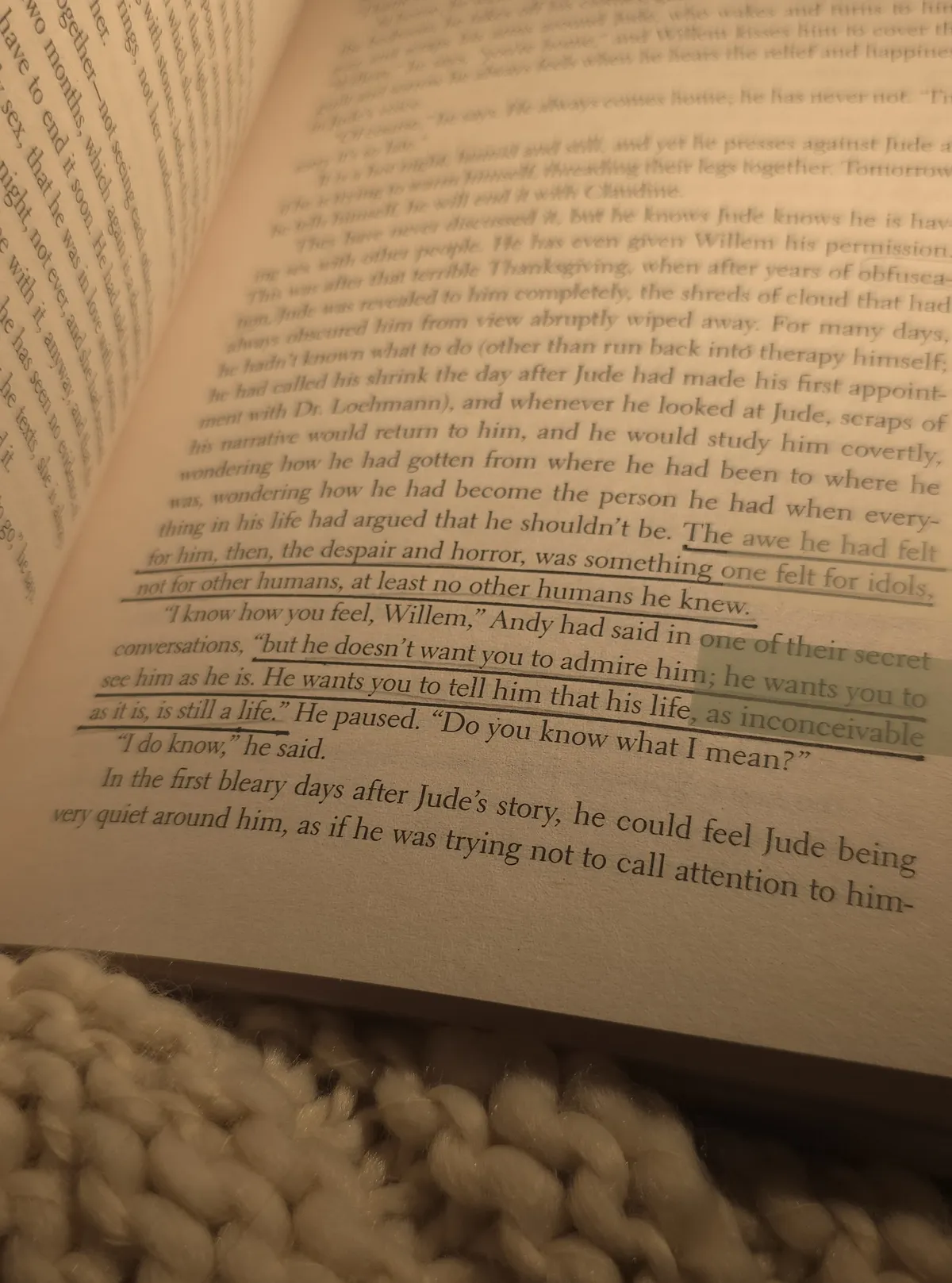
Almost one week after reading this book, all that’s left is Jude, all other characters, were accessories to his life. Imperfect, incomplete, always present, just trying. I initially saw it as a flaw, but now I see what she did there. They only things that gives away the fictional nature of the book is how emotionally intelligent are the male characters in this book!
In this way Yanigihara offers us the experience of first-, second- and third-hand trauma, the pain, the terror and the powerlessness that radiates far and wide from the hands of those that abuse. This powerful story captures the impact of trauma, over time and as it ripples out from the individual to others in their relational networks.
I can't help but think that in some ways fiction is far more effective in helping us understand the experience of the other. Scientific, theoretical and policy documents are all helpful and necessary adjuncts to our development as ethical and effective therapists, but good literature… there is no competition. We are transported into other worlds, they are not explained, we aren't told about events, we are invited to inhabit them. It is these experiences that can contribute to our own abilities to work with our clients, to hear about the horror of nights spent awake, with nothing but flashbacks to the faces of perpetrators. These experiences have to be imagined to be understood. Mere explanation only goes so far.
Major Themes
- Trauma that does not heal
- Self-harm as coping
- The limits and power of love
- Friendship as a sustaining force
- The violation of bodily autonomy
- Survival that does not transform into peace
Some other blog posts to read:
…Next one is going to be HeartBurn by Nora Ephron